The Hidden Gap That Kills Your Google Rankings
You wrote a great article. You checked your grammar. You added keywords. But your rankings in the UK are flat — or worse, invisible.
Here is the thing: what works on Google.com often fails on Google.co.uk. Not because of a technical glitch. Because of words.
A single wrong word can push your page off the first page entirely. And most businesses never find out why.
This guide shows you how to fix that. We will look at the UK vs US SEO keyword nuances that trip up even smart marketers — and how AI re-writing tools can close that gap fast.
Why "Same Language" Does Not Mean "Same Keywords"
British English and American English look alike on the surface. But they behave very differently in a search bar.
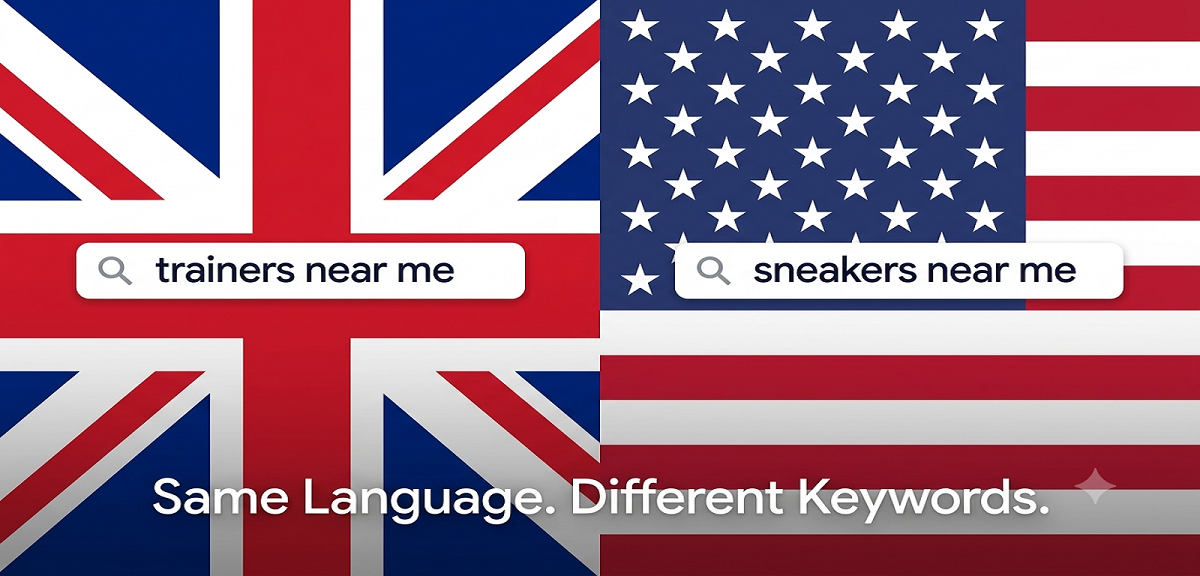
When someone in Manchester wants food delivered at night, they do not type "takeout near me." They type "takeaway near me." When a London shopper wants new shoes, they search for "trainers" — not "sneakers." A renter in Birmingham looks for a "flat to let," while someone in Boston searches for "apartment for rent."
These are not just spelling differences. They are search intent differences. Google sees "sneakers" and "trainers" as two separate topics with two separate sets of results.
This is the core problem with UK vs US SEO keyword nuances. Both markets speak English. But they do not search in English the same way.
The .co.uk Domain: More Than Just a URL
Many businesses treat the .co.uk domain as a simple address. It is actually a trust signal.
British users notice when a site ends in .co.uk. It tells them the business understands their market. It signals local relevance. And Google's UK search results tend to favor .co.uk domains when the query has local intent.
But the domain alone does not win rankings. The words inside the site matter just as much. A .co.uk site filled with American spelling. American slang, and American product names will still underperform — even with the right domain.
You need the right address AND the right language for that address.
Key UK vs US SEO Keyword Differences You Must Know
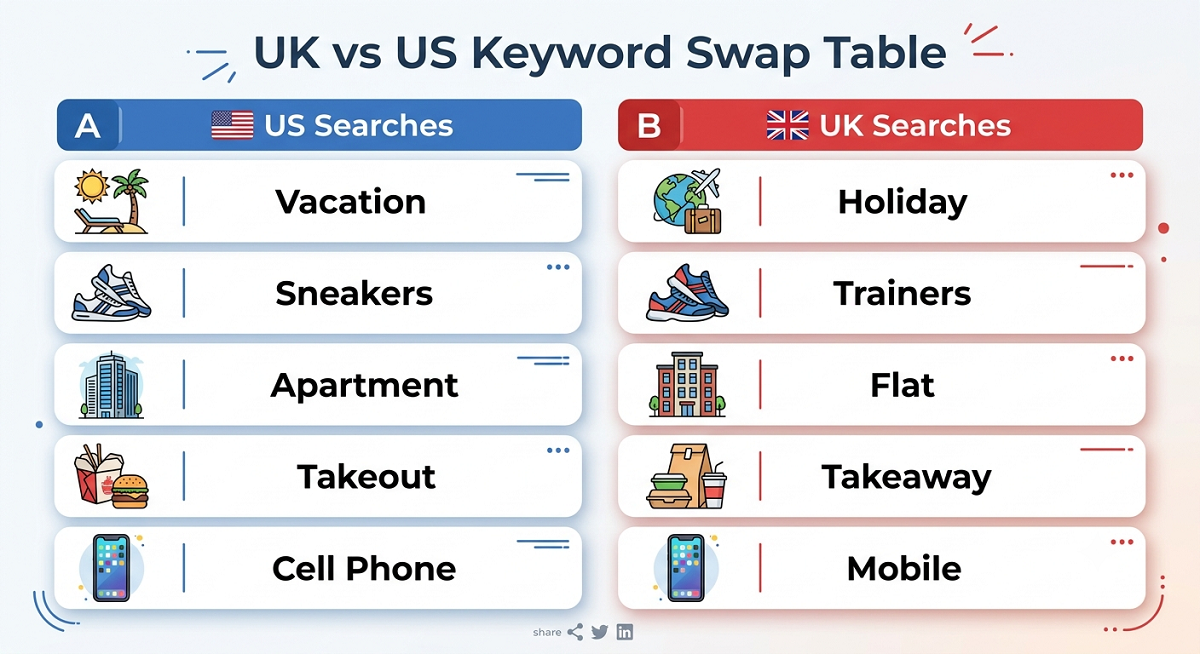
Here is a plain-English breakdown of the biggest keyword gaps between the two markets.
1. Everyday Words That Change Everything
US TermUK TermVacationHolidaySneakersTrainersApartmentFlatSweaterJumperDrugstoreChemistTrash canBinCell phoneMobileGasolinePetrolChipsCrispsFriesChipsTruckLorryElevatorLiftRealtorEstate agentTakeoutTakeaway
Each of these swaps represents a different search term with different volume, different competition, and different intent. Miss one and you miss the audience entirely.
2. Spelling Variations That Affect SEO
Google does account for some spelling differences. But not always — and not completely.
UK users expect British spelling. When they see American spelling on a .co.uk site, it feels off. It reduces trust. And reduced trust means lower time-on-page, higher bounce rate, and weaker rankings.
Key spelling shifts to apply:
-
-ize → -ise (optimize becomes optimise)
-
-or → -our (color becomes colour)
-
-er → -re (center becomes centre)
-
-og → -ogue (catalog becomes catalogue)
-
-ense → -ence (license becomes licence)
These changes matter in your meta titles, headings, body copy, and image alt text.
3. Date and Currency Formats
This one goes beyond keywords — but it affects user trust, which affects rankings.
In the US, dates go Month/Day/Year. In the UK, they go Day/Month/Year. In the US, prices use a dollar sign. In the UK, it is pounds.
A UK shopper who sees "$49.99" on a .co.uk site feels confused. A reader who sees "05/06/2026" might read that as June 5th (US) or May 6th (UK). These small details hurt your conversion rate — and Google notices when users leave without converting.
4. Cultural Reference Points
Americans write about Black Friday, Thanksgiving, the Super Bowl, and Labor Day. These events either do not exist in the UK or carry different meaning.
UK content should reference Boxing Day, Bank Holidays, the Premier League, Bonfire Night, and Guy Fawkes Night. UK Mother's Day falls in March. US Mother's Day falls in May. Targeting the wrong date for seasonal content wastes your entire campaign.
This is exactly where AI re-writers add real value — catching cultural mismatches a grammar tool would never flag.
How AI Re-writers Help You Localize SEO Content
An AI re-writer does more than swap spellings. A good one reshapes how a piece of content feels — its rhythm, its word choices, its cultural temperature.
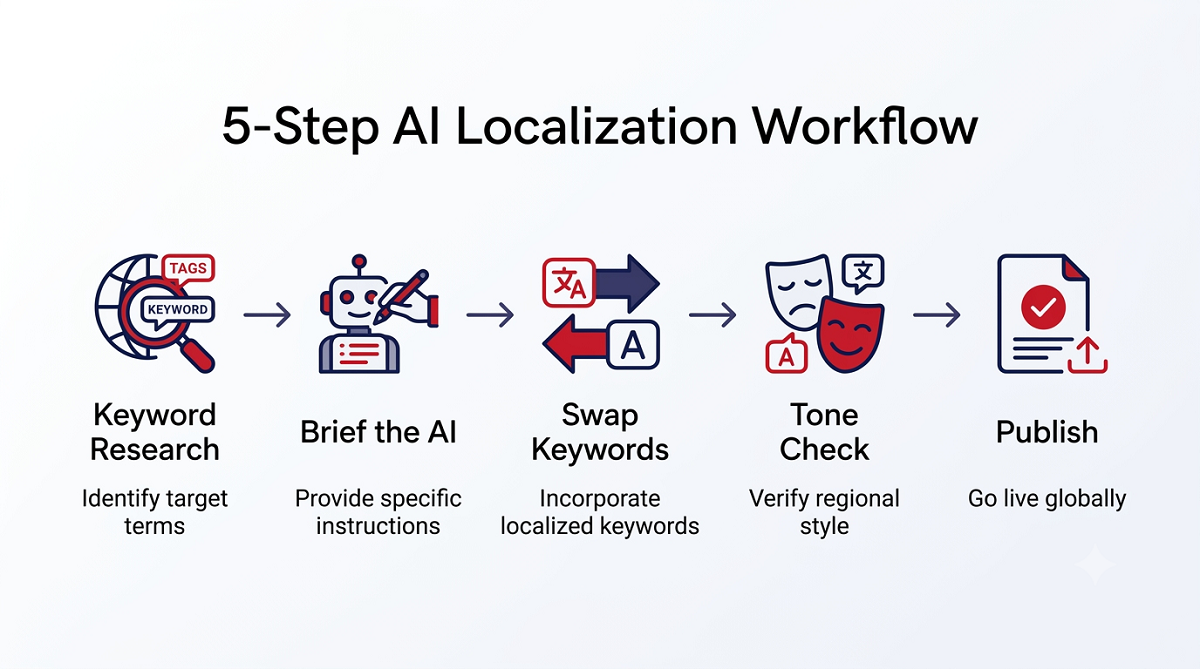
Here is the step-by-step process that works.
Step 1: Start With Market-Specific Keyword Research
Before you re-write anything, know what UK users actually search for. Use tools like Ahrefs, Semrush, or Google Keyword Planner — but filter results by country (United Kingdom), not globally.
Look for:
-
UK-specific search volumes for your core topics
-
Keywords your UK competitors rank for that you do not
-
Long-tail phrases with local flavor ("estate agents near me" vs "realtors near me")
This gives your AI re-writer a clear brief: use these keywords, not those.
Step 2: Brief the AI Re-writer Properly
Most AI re-writers allow you to set tone, region, and target audience. Do not skip this step.
Tell the tool:
-
Target market: United Kingdom
-
Spelling standard: British English
-
Avoid American idioms and cultural references
-
Replace US keywords with UK equivalents from your research list
The more specific your brief, the better the output. Vague inputs produce vague outputs.
Step 3: Swap Keywords Systematically
Run your original content through the AI re-writer with a keyword swap list. Every instance of "vacation" becomes "holiday." Every "sneakers" becomes "trainers." Every "cell phone" becomes "mobile."
Then review the output manually. AI tools are good at patterns — but they sometimes miss context. "Mobile" in a UK SEO article might refer to a phone or a mobile billboard. Only a human can tell the difference in context.
Step 4: Check Tone and Cultural Fit
British writing tends to be slightly more reserved than American writing. It is less aggressive in sales tone. It often uses dry humour. It values understatement.
A US-style headline like "EXPLODE Your Sales With This ONE Simple Trick!" would feel out of place on a UK site. A UK reader would find it overblown. They might click away.
Ask your AI re-writer to match a "British editorial tone" — then check the output for anything that still sounds like a US infomercial.
Step 5: Localize Meta Titles and Descriptions
Your meta title and description are the first things a UK searcher sees on Google. They must feel local — immediately.
-
Use British spelling in every meta element
-
Include UK-specific keywords in the title where natural
-
Reference UK context ("For UK Businesses," "Trusted Across the UK") where relevant
-
Avoid US-only references in snippets
AI re-writers can automate this across hundreds of pages at once — a huge time saver for larger sites.
The .co.uk Niche: A Competitive Edge If You Use It Right
Here is something most US-based businesses miss when entering the UK market: the .co.uk domain combined with properly localized content is a moat.
Most big US competitors do not bother to fully localize. They machine-translate or use a basic find-and-replace. Their UK content feels foreign to British users. Their bounce rates are higher. Their dwell times are lower.
That gap is your opportunity.
A properly localized .co.uk site — with correct British spelling, UK-specific keywords, culturally appropriate tone, and local references — will outperform a lazy localization from a bigger brand almost every time.
Google's algorithm rewards relevance. British users reward content that speaks to them. Both of these things point in the same direction: genuine localization wins.
Common Mistakes to Avoid
Relying on auto-translate alone. Machine translation catches words. It misses meaning. Always layer a human review on top of any AI-generated localization.
Ignoring on-page elements. Your body copy might be perfect British English, but your image alt text still says "sneakers." Google reads all of it.
Using one hreflang tag and calling it done. Hreflang tells Google which version of your content to show in which country. But it does not fix bad localization. You still need the right words on the right page.
Forgetting about backlinks. A US-heavy backlink profile does not transfer to UK rankings. Build citations and links from UK-based publications, directories, and industry sites to strengthen your .co.uk domain authority.
Copying UK spelling but keeping US cultural references. Colour instead of color is a start. But writing about Thanksgiving on a UK site still signals "this content was not made for you."
A Quick Checklist Before You Publish on .co.uk
Use this before any piece of content goes live on your UK site:
-
All spellings follow British English conventions
-
Target keywords are UK-specific (verified with UK keyword tools)
-
Prices show in GBP, dates in DD/MM/YYYY format
-
Cultural references are relevant to British readers
-
Seasonal content uses UK dates (Mother's Day in March, etc.)
-
Meta titles and descriptions use British spelling and UK keywords
-
Image alt text uses UK terminology
-
Tone is appropriate for a British audience (not over-the-top sales language)
-
Hreflang tags are correctly implemented
-
At least one UK-based source or reference is cited where relevant
Final Thought: Localization Is a Strategy, Not a Task
Most businesses treat UK vs US SEO as a one-time fix. Swap a few words, change the currency symbol, done.
But the brands that win on Google.co.uk treat localization as an ongoing strategy. They track which UK-specific keywords are climbing. They update seasonal content for British holidays. They build authority with UK media and directories. They audit their tone regularly.
AI re-writers make this faster and cheaper than ever before. But speed without strategy produces content that feels local on the surface and foreign underneath.
The UK vs US SEO keyword nuances are real, measurable, and important. Learn them. Localize around them. And build a .co.uk presence that British users — and British Google — actually trust.