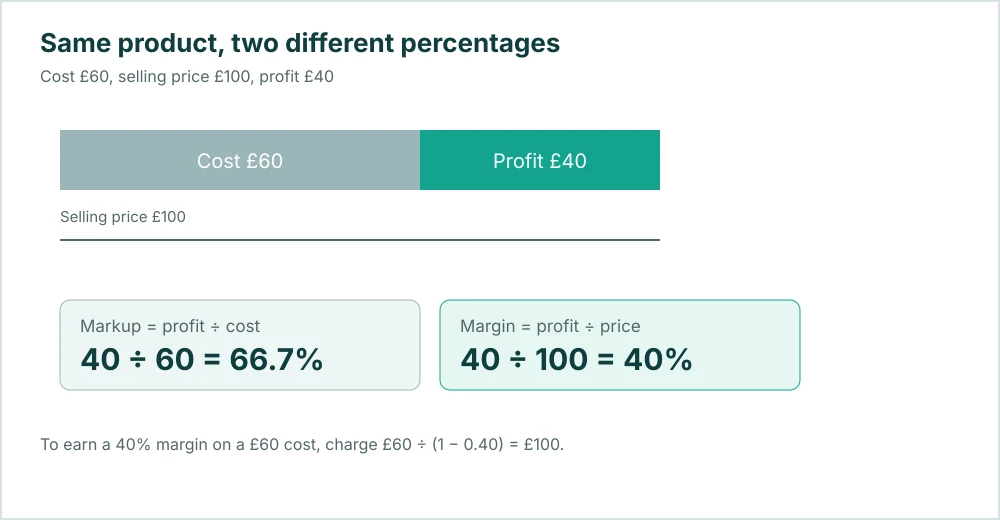
You buy a product for £60 and sell it for £100. Is that a 40% profit or a 66.7% profit? Both answers are correct, and that is exactly why so many small sellers misprice their stock. The two numbers are called margin and markup, and they are not the same thing.
This guide explains each one, shows how to switch between them, and gives you a simple way to set a price from the margin you want.
What is markup?
Markup tells you how much you add on top of your cost. The formula is:
Markup = (price − cost) ÷ cost
With a £60 cost and a £100 price, the profit is £40. Divide £40 by the £60 cost and you get 66.7%. You marked the product up by two thirds.
What is profit margin?
Margin tells you how much of each sale you keep. The formula is:
Margin = (price − cost) ÷ price
Same product, same £40 profit. Divide it by the £100 price and you get 40%. Out of every pound a customer pays, you keep 40p before other business costs.
The mistake that costs sellers money
Say you want a 40% margin and your cost is £60. Many people add 40% to the cost and charge £84. The profit is £24, and £24 is only 28.6% of £84. You are well short of your goal on every sale.
The fix is to divide, not multiply. To reach a target margin, use this:
Price = cost ÷ (1 − target margin)
For a 40% margin on a £60 cost, that is £60 ÷ 0.60 = £100. Another example: a £42 cost and a 30% margin gives £42 ÷ 0.70 = £60.
How to convert one into the other
- Markup = margin ÷ (1 − margin)
- Margin = markup ÷ (1 + markup)
A 25% margin equals a 33.3% markup. A 50% markup equals a 33.3% margin. A 100% markup, where you double your cost, is only a 50% margin. Margin can never reach 100%, but markup can go as high as you like.
Which one should you use?
Use margin when you think about profit and reporting, because it matches how accountants and marketplaces talk about profit. Use markup when you set prices from a supplier cost, because it is quick: multiply the cost by 1.5 and you are done. Just be sure everyone in your team means the same thing when they say "30%".
Count every cost first
Both formulas only work if your cost is complete. Include packaging, postage you pay, payment fees and marketplace commission, not just the supplier invoice. A product that looks like a 40% margin can be a 25% margin once fees are counted.
Also remember that margin is not the same as net profit. Rent, software, wages and advertising still need to come out of it. To see how many sales cover those fixed costs, read our guide to the break-even point.
A full example: pricing a mug
Suppose you sell printed mugs online. Add up what each sale really costs you:
- Blank mug from your supplier: £4.20
- Packaging: £0.60
- Postage you pay: £2.10
- Payment fee: £0.35
That is £7.25 in total. You want a 35% margin, so the price is £7.25 ÷ 0.65 = £11.15. You round it up to £11.49, which gives a profit of £4.24 and a margin of 36.9%. If you had marked up the £7.25 by 35%, you would have charged £9.79 and earned only a 25.9% margin.
What a discount does to your margin
Margin shrinks faster than most people expect when you run a sale. Take the £60 cost and £100 price from earlier. A 20% discount drops the price to £80. Profit falls from £40 to £20, and the margin falls from 40% to 25%. You earn half the profit on every sale, so you would need to sell twice as many items just to stand still.
Before you offer a discount, work out the new margin and the extra volume you need. If that volume is unrealistic, a smaller discount or a bundle offer is often safer.
Try it with your own numbers
Our free Profit Margin Calculator works out margin and markup from a cost and a price, or finds the price you need for a target margin. If you sell through ads, check your numbers against the guide to ROAS, ROI and ACoS too.
Quick answers
Is a 50% margin the same as a 50% markup?
No. A 50% markup is a 33.3% margin. A 50% margin is a 100% markup.
Can margin be higher than 100%?
No. Profit can never be more than the price, so margin tops out below 100%. Markup has no upper limit.
What is a good profit margin?
It depends on your industry, your costs and how much volume you sell. Compare yourself with similar businesses, and always check the figure after fees and fixed costs.